Okinawan Jujutsu
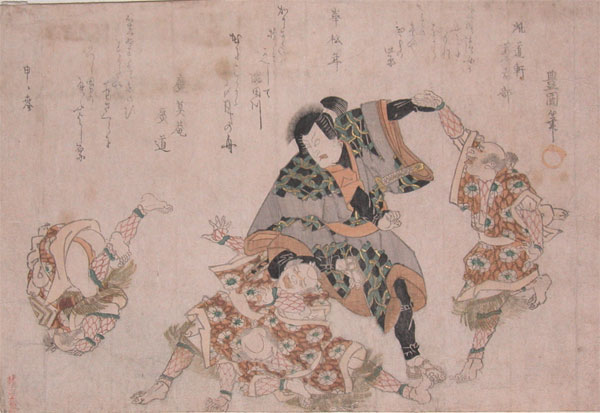
Image: "Jujutsu", 1815, Utagawa Toyokuni
Judo and Aikido are modern martial arts that descend from old samurai-era Jujutsu, called Yawara at that time. Although the combat effectiveness of Judo and Aikido today depend a great deal on how they are taught and practiced owing to a general de-emphasis on actual combat application in many of their dojo in favor of sport or spiritual applications, they still contain battlefield techniques designed to be used to defend oneself on the battlefield against battlefield weapons and attacks by an opponent wearing full armor, often but not always while one is in armor oneself. The techniques are to be used against fully committed strikes, not probing "jabs" with little to no body commitment behind them, because those types of strikes would be unlikely to penetrate armor. Also, old style Jujutsu, as well as early Judo and Aikido, all contain strikes (called atemi), but punching and kicking would only be of limited use against a person in armor; however throws, pins and joint locks would still be effective because armor must still be articulated to be able to fight in it.
A very over-simplified view: Aikido is skill in how to break someone's balance when they try to grip *you*. Judo is skill in how to break someone's balance when you grip *them*. In Judo, you tuck yourself into *their* center. In Aikido, you rotate them around *your* center, or a center between the two of you that *you* control. The techniques of Aikido tend to have more space between a person's body and that of their opponent, while Judo techniques tend to be applied much closer to the opponent, often with torsos touching. Dr. Kenji Tomiki, a high ranking practitioner of Judo and Aikido and founder of Tomiki-Ryu Aikido, who was taught directly by the founders of both arts, stated that Aikido could be described as "Judo at a distance".
Aikido and Judo practitioners are not taught how to flip and throw other people. They are taught how to flip and throw themselves. If an Aikido or Judo practitioner were able to successfully perform a technique on a person who was untrained in how to fall and flip themselves to relieve the pressure on their joints, that person would end up with joint and other falling related injuries. The fancy, flying through the air flips you see happening in a Judo or Aikido demonstration are the result of trained practitioners throwing themselves in a safe, injury-free way. These Aikido and Judo practitioners know how to fall, slap the mat, roll, etc to avoid injury. Just watch a Judo or Aikido formal practice with their kata vs a Judo Olympic competition to get an idea of how painful it would look to throw someone who didn't want to be thrown but got thrown anyway, and then imagine what you just witnessed happening on hard ground, a tile floor in the local convenience store, or sidewalk concrete.
The throws, joint locks and pins contained in the kata of Karate descend from the Okinawan art of Tegumi, or Shima (Okinawan wrestling). They are fewer in number than in Jujutsu, Aikido or Judo, but they tend to be those that the practitioners of those other arts would call "high percentage techniques", i.e. those most likely to succeed in combat. This basically means that Karate is "Okinawan Jujutsu". Additionally, The throws in the kata of Karate are "no-gi" throws. Karate was developed on Okinawa, a tropical island, where very often the clothing was minimal and made of thinner fabrics than in Japan. In many of the oldest photographs of Karate practitioners, they are shirtless and wearing only what would amount to surf shorts or capris pants today, so the throws had to be able to be applied on a shirtless person, in a society where fishermen, farmers, carpenters, etc., often went shirtless at least while working.
"Kata must always be performed exactly; Combat is another matter" ~ Funakoshi Gichin


Comments
Post a Comment